Wednesday, September 21, 2016


Tuesday, September 20, 2016
The Police Murder of Keith Lamont Scott
http://www.huffingtonpost.com/entry/charlotte-police-shooting_us_57e1c953e4b0e80b1b9efd69


Sign the Petition to Indict Officer Betty Shelby
Sign this petition: Justice for Terence Crutcher
Hi!
Too many Black lives are lost by the hands of police. I just took action with Color of Change calling on the arrest of the officer that shot and killed Terence Crutcher!
Join me today.
http://act.colorofchange.org/sign/terence-crutcher-justice/?sp_ref=231224606.176.175436.e.555175.2&referring_akid=6301.2187383.o2TcYY&source=em_sp


Thursday, September 15, 2016
Teen Rapes Toddler Gets Away With It
http://www.rawstory.com/2016/09/judge-spares-prison-for-iowa-teen-who-raped-toddler-girl-in-live-video-and-plotted-to-assault-boy/ teen rapes toddler, gets away with it.
Americas Greatest Fear - Income Inequality
By Nicole Sinclair - Original Article
“The confused national discourse about our economy and future prosperity in this election year is our worst nightmare,” Harvard Professor Michael Porter writes. “There is almost a complete disconnect between the national discourse and the reality of what is causing our problems and what to do about them. This misunderstanding of facts and reality is dangerous, and the resulting divisions make an already challenging agenda for America even more daunting.”
In its just-released report on competitiveness, “Problems Unsolved and a Nation Divided: State of US Competitiveness,” Harvard Business School (HBS) found the US economy currently faces grave concerns. And the path to a solution—namely tax reform, immigration reform, and infrastructure investment—is being hindered by the current political climate.
Led by Porter, along with Professors Jan Rivkin and Mihir Desai, the report finds that since the launch of the US Competitiveness Project in 2011, concerns about weak job creation and stagnating incomes—particularly for the middle class—have not waned.
The severe 2009 recession is not the cause of our slow recovery
Porter explains while many pundits and politicians have focused on the Great Recession to diagnose America’s economic woes, this is misguided.
“Despite the hope of finding reasons for optimism, the ‘recovery’ remains slow and uneven, largely because America’s competitiveness problems took root long before the downturn,” Porter writes. “Since those problems remain unsolved, it should not be surprising that the average annual economic growth (1.6%) during the current recovery is slower than during any recovery since the late 1940s.”
The report adds that the wrong diagnosis, along with political paralysis in Washington, has meant that we have made no meaningful progress on any of the critical policy measures needed to address the nation’s underlying competitive weaknesses—which would restore economic growth and also the standard of living for the average citizen.
“America’s economic strategy defaulted to trusting that the Federal Reserve could solve our problems through monetary stimulus,” according to the report.
The key problem: Lack of shared prosperity
Porter says the key issue for America today is a lack of “shared prosperity,” as working and middle-class citizens are struggling.
“The lack of shared prosperity has rightly been a central issue in the 2016 campaign, but the diagnoses and proposed solutions are way off the mark,” the report points out.
As the middle class began to stagnate amid globalization and technological change, instead of increasing investments, the US made “unsustainable promises” to maintain the “illusion of shared prosperity,” the report notes. That included extending credit, expanding entitlements and increasing public-sector benefits.
The report points out that while politicians resort to blame—from immigrants to Wall Street to well-off Americans to other countries, big business and international trade—the solutions offered are “emotionally appealing but simplistic and deeply misguided.”
The HBS report focuses on solutions to make the US more competitive, allowing businesses to compete in domestic and international markets while improving wages and living standards of the average citizen.
“When these occur together, a nation prospers,” according to the report. “When one occurs without the other, a nation is not truly competitive and prosperity is not sustainable.”
Lackluster growth: A breakdown of metrics
The manifestation of competitiveness is productivity, Porter explains. A nation can only compete successfully and pay rising wages through high value of output per worker and per dollar of capital invested.
But productivity growth has been stuck below long-term levels, hitting negative territory in the last three quarters.
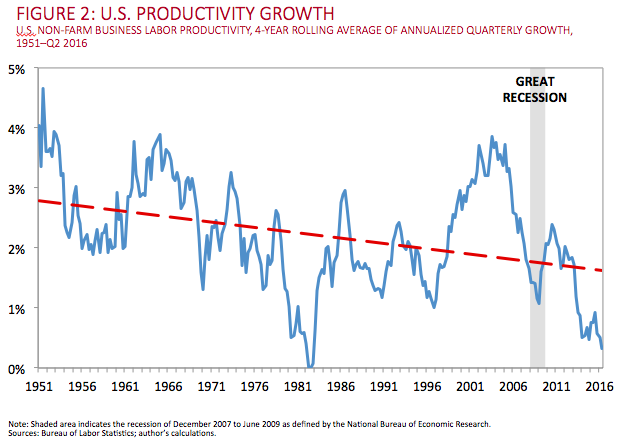
Wages have stagnated and business investment is also lagging given uncertain prospects.
As the report highlights, between the 1970s and 1990s, the US economy created private sector jobs at a long-run rate of 2% per year. But the rate, which began to decline around 2001, remains well below historical standards.
The report adds that not only has job growth slowed but most of the jobs created since 2000 have been in “local” industries such as health care, hospitality, and business services. Local jobs—as opposed to “traded jobs” that are exposed to international competitions such as machinery and IT equipment—pay lower average wages.
And slow job creation has led to low workforce participation, or the proportion of working age Americans in the active workforce, which peaked in 1997—well ahead of the Great Recession.
The report points out that while some observers have minimized declining workforce participation to retiring baby boomers, the bigger drivers are weak demand for low-skilled labor along with high incarceration rates of low-skilled men. Meanwhile, baby boomers are actually working longer than historical norms. While the official unemployment rate has improved to 4.9% for the entire population and 5.1% for the working population (ages 16-64), the report points out that if workforce participation stayed at the level seen in 1997, current levels of employment would imply a rate of 11.1% for the working population.
“Given the number of potential workers sitting on the sidelines, not in the official workforce but eligible to work, talk of a tightening labor market seems premature, especially for lower-skill and lower-income workers,” according to the report.
This helps set the stage for why wages and income levels for Americans have been under pressure, particularly for lower-income groups.

Meanwhile, the annual growth rate of quarterly private investment in intellectual property, structures and equipment remains weak, falling below historical rates, according to the report. For 2010-2016, the average quarterly investment by business as a percent of GDP was lower than it has been since the 1980s, hurting productivity further.
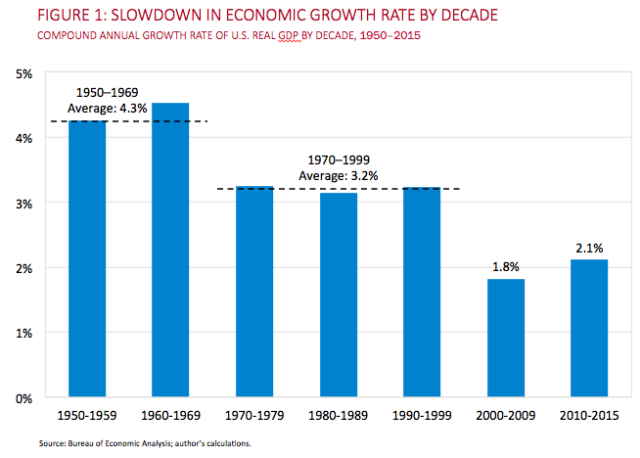
And all of this comes as GDP growth has remained tepid for a longer period than realized, on a downward trajectory since the 1960s with a significant step-down beginning around 2000.
Porter says the key barrier to progress is the political system.
“We’ve concluded after these five years of work on this that actually the political system and the political rhetoric is the problem at the core,” Porter said. “Because of the political gridlock we’ve not been able to make any progress on a lot of the basics.”
For more on the study, please see below:

Saturday, September 10, 2016
Consumer Reports Article - The Rise of Medical identity Theft
The Rise of Medical
Identity Theft
When thieves take your
personal data to get prescription drugs, doctor care, or surgery, it can
endanger your health and trash your finances
By Michelle Andrews
August 25, 2016
It began like an ordinary purse snatching. The credit card
reader on the gas pump at her Houston neighborhood station wasn’t working, so
Deborah Ford went inside to pay. By the time she returned to the car, her purse
and wallet were gone. Ford filed a police report, canceled credit cards, and
requested a new driver’s license and health insurance card. She checked with
the bank several times to be sure nothing was funny, then forgot about it.
Two years later, the retired postal worker
received an unsettling call from a bail bondsman; she was about to be arrested
for acquiring more than 1,700 prescription opioid
painkiller pills through area pharmacies.
“I had my mug shot taken, my fingerprints
taken,” she says. Ford suffers from psoriasis,
and she was so stressed that she broke out in the signature rash. “The policemen
looked at my hands and said, ‘That’s what drug users’ hands look like.’ They
just assumed I was guilty.”
Later, a judge dismissed the charges. “What
saved me from going to jail was that I had filed that police report,” Ford
says.
Turns out the thief altered Ford’s driver’s
license and used that and her stolen health insurance card
to go to doctors to seek prescription painkillers. Eventually, Ford says, a
pharmacist became suspicious and called police.
“Boy, the thieves messed me up,” Ford says now
of her lengthy and expensive ordeal, which began with the theft in 2008 and
didn’t end until she got her name cleared of the arrest record last year. “Once
they’ve got your identity, they’ve got you,” she says.
Inside Medical Identity Theft
Ford’s story is but one glimpse of what
medical identity theft can look like these days and why it has become a
fast-growing strain of identity theft, with an estimated 2.3 million cases identified
in 2014, a number that’s up almost 22 percent from the year before.
Your personal health insurance information,
including your Social Security
number, address, and email address, is valuable and vulnerable. When
it gets into the wrong hands it can be used to steal expensive medical
services—even surgeries—and prescription
drugs or to procure medical devices or equipment such as
wheelchairs.
Your medical identity is a commodity that can
be hijacked and used to falsify insurance claims or to fraudulently acquire
government benefits such as Medicare or
Medicaid. Your personal medical information may also be sold on the black
market, where it can be used to create entirely new medical identities based on
your data.
And more often than you might imagine, people
outright share their own medical coverage with an uninsured friend or family
member in need of care, which is against the law. (More on that later.)
Because current consumer protections aren’t
specifically designed for medical identity theft, experts warn, people need to
understand that they may have to take on extensive work to clear up fraudulent
bills. Some frustrated victims of medical identity theft simply give up and pay
the bills themselves.
But there’s another, far more dangerous
problem with medical identity theft: The thief’s own medical treatment,
history, and diagnoses can get mixed up with your own electronic health
records—potentially tainting and complicating your care for years to come. And
that isn’t a hypothetical problem.
“About 20 percent of victims have told us that
they got the wrong diagnosis or
treatment, or that their care was delayed because there was confusion about
what was true in their records due to the identity theft,” says Ann Patterson,
a senior vice president of the Medical Identity Fraud Alliance (MIFA), a group
of several dozen healthcare organizations and businesses working to reduce the
crime and its negative effects.
Havoc in Victims' Lives
The long tail on medical identity theft can
create havoc in victims’ lives. Take Anndorie Cromar’s experience. A pregnant
woman reportedly used Cromar’s medical identity to pay for maternity care at
a nearby hospital in Utah.
Soon, officials from child protective services
assumed the infant—born with drugs in her system—was Cromar’s baby, and Cromar
says the state, not realizing her medical identity had been hijacked,
threatened to take her own four children away.
A DNA test she took helped to get her name off
of the infant’s birth certificate, she says, but it took years to get her
medical records corrected.
“That first stage was the most terrifying
thing I’ve ever experienced in my life, getting the call from CPS and having
them say, ‘We are coming to take your kids,’ ” Cromar told Consumer Reports.

An Insidious Kind of Fraud
Financial identity
theft is nothing new: Perhaps you or someone you know has had
to deal with undoing the mess that happens when someone illegally obtains your
personal financial information and uses it to drain your bank account or
rack up charges on credit cards fraudulently
taken out in your name.
Setting credit accounts back to normal can be
a hassle, but your money is, for the most part, protected under the Fair Credit
Billing Act. You’re liable for only $50, at most, of unauthorized charges on a credit cardif
you follow simple notification steps. And there are defined reimbursement rules if money is illegally withdrawn with
a stolen ATM or debit card.
But when consumers become victims of medical
identity fraud, stopping the damage and clearing up the bills is much more
difficult and time consuming.
Deborah Ford had to quickly figure out what
had been done in her name and try to undo the damage. She got on the phone and
wrote letters and even tried to track down doctors the criminal had used. “All
I have is my name, my integrity,” she says.
Investigators later told her that the thieves
were savvy at knowing the system, always waiting 45 days between trips to the
same pharmacy to avoid being identified by store video. “They were so slick
about it,” Ford says. ‘To this day, I don’t know who they were. But they were
slick, that’s for sure.”
Spotting It, Preventing it
Experts say detecting the fraud in the first
place can be the most difficult part. “Medical identify theft and fraud is much
harder to spot than financial fraud,” says Michelle De Mooy, acting director of
the Privacy & Data Project at the nonprofit Center for Democracy &
Technology. “The bank calls you if they see charges in the system that raise an
alarm. This kind of fraud is much easier to hide for a longer time.”
That’s why consumers need to be especially
smart and careful about how and when they share their personal, medical, and
insurance information.
Here are a few basic ways you can safeguard
your medical privacy and identity: Read those explanation of benefits letters
as if they were bank statements. Carefully check all of the correspondence you
receive from health insurers and healthcare providers for accuracy and for
bills of service that you don’t recognize. Also review your credit reports for
unfamiliar debts. Be stingy with your personal health information, Social
Security card, and insurance cards. If someone asks for them, inquire whether
it is really necessary.
And don’t post news of an upcoming surgery on Facebook or
other social media outlets, Patterson recommends. You can’t really be sure who
might see it. Consider, for example, that a criminal could scoop up the notice
of your impending hip replacement and
add it to other information he or she can easily find about you online,
creating a more robust, more exploitable personal profile. As Eva Velasquez,
president and CEO of the ITRC, says, “Our rule of thumb is if it’s not
something you’d want plastered on a billboard, don’t post it. Because
essentially every single thing you post has that potential.”
All in the Family
Ronnie Bogle, a museum supervisor from San
Jose, Calif., says that for more than a decade, he had no idea that his brother
Gary had been stealing his identity to secure healthcare across several states.
Gary had a simple routine, Ronnie says: He
would move to a new town or city, purchase a picture ID, then present the ID—along
with Ronnie’s Social Security number—to get treatment, often at hospitals. Gary
often claimed to be uninsured when he sought care. After he was treated, the
bills were later sent to his given address, not Ronnie’s.
Ronnie told Consumer Reports that he only
learned what Gary was up to in 2010 after applying for a new credit card and
being turned down. He says his credit report contained listing after listing of
unpaid debt—for his brother’s hospital visits and treatments over the years.
Eventually, Gary was arrested and pleaded
guilty to 10 counts of criminal impersonation in California. He’s facing more
charges in Washington state for allegedly stealing his brother’s identity
there.
It has taken two years for Ronnie Bogle to
straighten out his credit and get his brother’s medical bills off his financial
record. “He destroyed my credit history multiple times,” Ronnie says.

So-Called Friendly Fraud
Sometimes victims of medical identity theft
know exactly how the crime occurred, but for others it remains a mystery.
The Ponemon Institute, a private cybersecurity
research firm, surveyed 1,005 people whose medical identity was “most likely”
assumed by someone else. In the study, published last year, 10 percent of
victims said their event was the result of a healthcare provider or insurer
data breach, and an additional 12 percent believe they were tricked into giving
up personal information via a fake email or phony website.
But 47 percent of respondents said that their
identity theft was perpetrated by a relative or someone else they knew.
Twenty-four percent said they had a situation like Bogle’s, where a relative
stole their identity without their knowledge or consent. And surprisingly, an
additional 23 percent of respondents said they willingly shared their
credentials with someone they knew. That’s why the crime sometimes is referred
to as “friendly fraud.”
Of those who said they shared healthcare
credentials in that way, 91 percent reported that it was because the other
person had no health insurance and 86 percent said it was because the other
person couldn’t afford medical treatment. Sixty-five percent said it was done
in an emergency.
Most of the people who voluntarily let someone
they know use their medical information said they didn’t consider their actions
wrong or criminal.
“They think of it as a Robin Hood crime—that
no one is getting hurt and that if a family member is ill, they can help them,”
says Larry Ponemon, chairman of the Ponemon Institute.
“Those in our studies who did recognize it as
a crime saw it as minor, like driving 5 miles above the speed limit. They don’t
recognize the cost burden to insurance companies or healthcare providers, or
that it ultimately ends up in the lap of consumers.”
Knowingly allowing a friend or relative to use
your medical insurance is illegal, an act of fraud against insurance companies
and health providers. And wrongfully sharing Medicare or Medicaid benefits is a
crime against the federal government and state programs.
Pinpointing how much money fraud costs the
medical industry each year is difficult. One estimate from 2012 put the total
economic impact of medical identity theft in the U.S. at $41.3 billion.
Providers are working on new strategies to
prevent it. They’re using software to detect fraud in billing, training staff
and consumers to recognize warning signs and asking for photo IDs, explains
James Quiggle of the Coalition Against Insurance Fraud. He says consumers can
expect to see more extensive verification screening in the future, such as the
use of fingerprints or palm prints. And soon Medicare cards will no longer bear
Social Security numbers.
A Dramatic Rise in the Crime
As recently as six years ago, your medical
information was kept in paper files, but now it has a more robust virtual
life—in electronic health records and in details you share online. All of that
can increase the likelihood that the wrong people could gain access to your
data.
“Now there’s electronic data traveling through
all kinds of devices and networks, and it’s much harder to lock it down,”
Patterson says.
Big data breaches in
the medical care industry have been on the rise over the past decade, including
the hack of health insurer Anthem in
2015, when about 70 million of its records were reportedly stolen. And yet it’s
still unclear how often medical identity fraud stems from those kinds of hacks,
Patterson explains.
Most at Risk for Medical Identity Theft
What industry analysts do know is that some
people are more likely to become targets, including people on Medicare. “That
Social Security number on the card is a gateway, not just to medical fraud but
to all kinds of fraud,” Patterson notes.
Older adults might also be more susceptible to scams because
they tend to be less circumspect about giving up personal health information,
she adds. Children’s health records are aggressively pursued by criminals, it
turns out, because a minor’s credit report—which would list unpaid debts—isn’t
usually seen by parents until a child is old enough to secure credit in his or
her name.
Also particularly vulnerable to medical
identity theft, says Pam Dixon, executive director of the nonprofit World
Privacy Forum, are new mothers, surgery patients,
and people with chronic conditions such as diabetes or
serious illnesses such as cancer.
That’s because the more interaction you have with the healthcare system, the
more opportunity for records to be breached.
Anyone who casually puts a lot of personal
information on social media sites and apps, such as millennials,
might attract medical identity thieves, too. Criminals, Patterson explains, are
“very good at aggregating social media information and pairing it with health
and other data they’ve gotten, like dates of birth and addresses.”
The Chaos in Care
The effects of medical identity theft can be
far-reaching, costing victims time, money, and aggravation. A 2016 report from
Javelin Strategy & Research found that, on average, identity fraud victims
spent only $55 out of pocket to resolve financial account problems in 2015.
But 65 percent of the medical identity theft
victims surveyed by Ponemon said they spent an average of $13,500 to pay the
healthcare bills run up in their name, to recover their health insurance, and
to pay lawyer’s fees, among other things. Ponemon also found that it took an
average of more than three months for victims to even detect the fraud and more
than 200 hours to undo the mess.
Mary Levine of Lake Charles, Louisiana, says
she has been logging time on the telephone with the police, hospitals, doctors,
and Medicaid almost every day since she learned in mid-June that someone had
racked up some $20,000 in fraudulent medical bills using her identity. Although
Levine is working closely with the nonprofit ITRC and her local sheriff's
department, the bills continue to arrive, and her worries are mounting.
"I keep telling the hospital that I've
never been there," says Levine. "I've been calling nonstop. They just
say they have not clarified anything at all and they'll call me whenever they
make a decision."
There’s much more to do to safeguard consumers
from medical identity theft, experts say, including creating a defined process
for resolving medical and financial problems.
But, says Orly Avitzur,
M.D., M.B.A., Consumer Reports’ medical director, one thing that healthcare
experts don’t want is to completely lock up our medical data. “It’s important
for doctors to be able to share your health needs, diagnoses, and treatment
information with each other, and to do so quickly in the event of an emergency,”
she says.
Be Ever-Vigilant
Deborah Ford’s encounter with medical identity
theft may have been extreme, but the way she handled it was impressive. Once
she found out about the fraud, she got on it—alerting every entity involved—
and stayed on it until it was over.
“They never used my credit card or checking account;
I checked. But lo and behold, they did more than that. They got what they
wanted—my insurance information,” she says.
Still, it cost her $1,500 in fees and took
five more years to expunge the drug arrest. On that day, Ford says, “I got my
name back.”
Thursday, September 8, 2016
Seeking Brave Subjects of Custody Evaluation Fraud Connecticut

SEEKING BRAVE SUBJECTS OF CUSTODY EVALUATION
FRAUD
CONNECTICUT
On 4/22/16 Judge Erica Tindill reversed
a Protective Order that she granted weeks before. The temporary custody
returned two children who escaped from the hands of the accused abuser, back into the total
control of the person whose acts described were so compelling that temporary custody
was granted and a criminal police investigation was begun.
On 4/22/16, the afternoon
before a Jewish holiday, Tindill ordered the children back into the hands of
the hell escaped. The order allowed no time to file a motion to stay pending
appeal......... no time to prepare, only time for collapse into utter emotional
devastation for all involved.
This Order written by Judge Erica Tindill was predicated on the testimony of Eric
Frazer, Psy.D./”Yale”,who practices in
Westport, CT. . Despite the fact
that Eric Frazer /”Yale”, had not seen or spoken with the subjects of Judge
Erica Tindill's Protective Order in five years, that he never met or spoke with
other critical family members, party to this current action, Eric Frazer /Yale
was allowed to opine at length as to their mental status, character and
fitness. Frazer/ Yale placed on a public, court record, a scathing indictment
of people he never met, with whom he never spoke. As to those with whom he did
meet, his interaction was so brief, so superficial, so laced with bias, malice,
intent to suppress evidence and intimidate witnesses to depraved crimes, that
the psychological report he produced and submitted should have been given
absolutely no weight if properly cross examined by a competent professional.
The report was never cross examined in court at all.
Frazer was further, allowed to
attest to the mental status, fitness of the accused abuser in the most glowing
terms. Frazer supported the accused abuser's fitness and character as evidenced
by his position as a Camp Director at the prestigious Wood Way Country
Club, where he lectures to camp staff on
the signs and symptoms of child abuse. Frazer neglected to point out that
camps, schools, youth groups are hunting fields for predators cloaked as
pillars of the community, reputations supported by other predators and
prevaricators.
It is important to note that
Eric Frazer's original work project was never vetted by
opposing expert witness
testimony. If such opposition had been allowed to come to light, the fact that
the child subjects of the “evaluation” had been seen for a brief period of time
and that no battery of psychological testing, as part of a proper protocol of
evaluation was ever performed. Eric Frazer's highly subjective, transactional
commentary was allowed to stand as a recommendation to transfer custody from a
Protective mother into the hands of an accused abuser. The Protective Parent
was assaulted with accusations of such malignant, toxic pathology, despite no
scientific, factual basis, that the chilling impact of such pronouncements from
Frazer caused the court to rise to a crescendo of resolution tantamount to “off
with her head” - custody, decision
making in all areas are transferred...... to the hands of the accused abuser.
A thorough reading of the case
history, court proceedings suggest that transfer, conscription of all decision
making in the area of medical, educational, psychological, family contact,
speech, have been made in the service of covering criminal acts on behalf of
the accused abuser.
The Foundation for the Child
Victims of the Family Courts is requesting that anyone whom has had similar,
direct experience with Eric Frazer, Psy.d./Yale, to please contact the FCVFC at
their confidential phone number through the US Whistle Blower, 888 – 789 –
3116, or contact us by e mail at: fightbackatuswhistleblower.org
Dr. Jill Jones-Soderman
Friday, September 2, 2016
Wednesday, August 31, 2016
Monday, August 29, 2016
The National Anthem: Symbol of Rascism
What you do not know about the National Anthem?
It glorifies the murder of slaves and was written by a bigoted racist. President Woodrow Wilson made the poem written by Francis Scott Key the national anthem, he himself was a racist and he signed legislation into law ...written by bankers...that is the cause of all of our financial woes today...the enactment of the FEDERAL RESERVE.
Key fought for slavery and his family made a fortune supporting slavery. As Washington, DC District Attorney, he inflicted many injustices on black people. He is a poster child of a racist.
Key fought for slavery and his family made a fortune supporting slavery. As Washington, DC District Attorney, he inflicted many injustices on black people. He is a poster child of a racist.
See this story on him: http://www.nydailynews.com/news/national/king-stand-star-spangled-banner-article-1.2770075
See the poem here:
Defence Of Fort Mchenry (Stars And Stripes Forever) -
Poem by Francis Scott Key

O! say can you see, by the dawn's early light,
What so proudly we hail'd at the twilight's last gleaming,
Whose broad stripes and bright stars through the perilous fight,
O'er the ramparts we watch'd, were so gallantly streaming?
And the rockets' red glare, the bombs bursting in air,
Gave proof through the night that our flag was still there -
O! say, does that star-spangled banner yet wave
O'er the land of the free, and the home of the brave?
On the shore, dimly seen through the mists of the deep,
Where the foe's haughty host in dread silence reposes,
What is that which the breeze o'er the towering steep,
As it fitfully blows, half conceals, half discloses?
Now it catches the gleam of the morning's first beam,
In full glory reflected now shines on the stream -
'Tis the star-spangled banner, O! long may it wave
O'er the land of the free, and the home of the brave.
And where is that band who so vauntingly swore
That the havock of war and the battle's confusion
A home and a country should leave us no more?
Their blood has wash'd out their foul foot-steps' pollution,
No refuge could save the hireling and slave,
From the terror of flight or the gloom of the grave;
And the star-spangled banner in triumph doth wave
O'er the land of the free, and the home of the brave.
O! thus be it ever when freemen shall stand
Between their lov'd home, and the war's desolation,
Blest with vict'ry and peace, may the heav'n-rescued land
Praise the power that hath made and preserv'd us a nation!
Then conquer we must, when our cause it is just,
And this be our motto - 'In God is our trust! '
And the star-spangled banner in triumph shall wave
O'er the land of the free, and the home of the brave.
Francis Scott Key
Wednesday, August 24, 2016
Hundreds of Thousands of Children Killed With U.S. Tax Dollars - Felony Murder Rule -You Can Be Legally Charged With Murder and Not Kill Anyone
Andrew Cockburn documents The Rise of the High Tech Assassin. Hundreds of thousands of children killed by U.S. tax dollars.
Remember all the police who were put on admin paid leave after killing Blacks? They are coming back to the job now. Kill a nigger, get paid vacation, come back to work after the heat dies down.
How you can be charged with a murder, legally, even though you did not kill anyone. That is right. Check out the Felony Murder Rule. Police officers nationwide are killing people then charging others for the murders and they are getting away with it, legally.

Subscribe to:
Posts (Atom)