Wednesday, October 5, 2016

Monday, October 3, 2016
October 2016 begins with shootings in Los Angeles by Police
http://www.cnn.com/2016/10/03/us/los-angeles-police-shooting/
Two blacks killed by police in less than two days.
Two blacks killed by police in less than two days.
Friday, September 30, 2016
What We Can Do

What can we do? First, form citizens oversight committees to
oversee police, courts and other government officials. Get involved.
Realize that we are in inverted totalitarianism and the
levers of power have been seized by the ruling class and we only are lead to
believe that we have true democracy. Manufactured consent results in comments
like “We must support our police", when we live in a police state…yes…a police
state (why do you think we have police getting military equipment….tanks,
machine guns….this is for the coming of the failure of capitalism). Remember:
Police and Blackwater troops have already been used against American citizens
in New Orleans. They turned their guns against poor blacks trying to escape the
flood waters of hurricane Katrina and shot some of them dead.
Robots are taking the jobs and they are not coming back. The
idea of exchanging money for labor is obsolete. The wealthy see this coming and
they are ensuring that we have a strong military and police force to defend
them. There is an acute shortage of natural resources, including water…the war
in Syria is a resource war over water.
Examine white privilege and the damage it does to us all …along
with income inequality.
Black slaves and their families never got the 40 acres and a
mule that were promised to them. Blacks have never been able to participate in
the capitalistic system. Reparations could include a permanent tax free status
for blacks to make up for 500 years of slavery, Jim Crow, inequality, dishonored
treaties, destroyed legacies, loss of interest and property…….. and injustice.
A formal apology for slavery and Jim Crow should be issued.
Slaves should be honored for their uncompensated labor that made this country
great.
Evaluate: communities of color and poor communities have
been chained by the justice system and prisons …and…these chains are being
readied for the rest of us.
The ruling class does not want to see us at peace or to see
our families happy or healthy.
They want to reduce the population. Why do you think they
prosecute wars and fight so hard to prevent universal healthcare. 66% of our
budget goes to war…not to schools, not to hospitals, healthcare, housing..the
weak and vulnerable….in fact, only 1% goes to anti-poverty programs and they
keep wanting to cut that to reduce the deficit.
Stop the war on drugs and mass incarceration. Invest into
new schools instead of new prisons.
Eliminate student loans and make education free for all (we
can afford it) the bloated defense budget is proof of that. European nations,
Asian nations…do not have to have large military forces. OUR TROOPS are protecting
them, so, they have four day work weeks and massive paid vacations.
Reevaluate this primitive tradition of locking up criminals.
Let’s rehab them…as they do in Europe.
Let’s treat our elderly with dignity. Build Disney like
facilities that have buildings, food, music…like the old times and allow them
to live out their lives in dignity (this is done in Europe…down to having old
cars). THIS instead of horrible nursing homes.
Eliminate items and
institutions that honor the Confederacy…as Germans have done with the Nazi’s and
Hitler. No more Robert E. Lee High and black cheerleaders wearing “The Rebels”
on their uniforms. No more Edmund Pettis Bridge. No more Confederate flags.
Black people should not be forced to honor the Confederate criminals no more
than Jews should be forced to honor Hitler and the Nazis or Americans to honor
Osama Bin Laden, The Taliban.
The black community has always been a canary in the coal
mine. What happens to them eventually happens to all. The police that kill
black men now, will kill others, later.
Just as conservatives and neo liberals engineered the drug
wars to destroy the civil rights movement and communities of color in the 1960’s,
now, white males are dying at higher numbers than anyone else in the addiction
war.
Most of us, have been taught what to think, not how to
think. The lame stream media creates this false picture of police and military forces
with all the police shows, movies and embedded news anchors.
We have to tell
our own stories, to know the truth.

Wednesday, September 28, 2016
Hannibal B. Johnson: Special Broadcast - The Worse Race Riot in U.S. History
Special Broadcast: Featuring Hannibal B. Johnson, Esq. as we discuss the mass killing of black people by whites in Tulsa, OK in 1921.
 |
| Tulsa, OK 1921. The total number of black people killed will never be know. |
Progress in the World Radio Show
9 AM to 11 AM
Monday, 26 September 2016
http://www.blogtalkradio.com/progressintheworld/2016/09/26/special-broadcast-hannibal-b-johnson--the-worst-race-riot-in-us-history
http://www.blogtalkradio.com/progressintheworld/2016/09/26/special-broadcast-hannibal-b-johnson--the-worst-race-riot-in-us-history
Call in Number 310-861-2349

The interview with Hannibal will take place between 9 AM and 10 AM.
Callers will be able to vent their opinions between 10 AM and 11 AM.
Join us and share this event.
Hannibal B. Johnson is a graduate of Harvard Law School.
He did his undergraduate work at The University of Arkansas, where he completed
a double major in economics and sociology. Johnson is an attorney, author, and
independent consultant specializing in diversity & inclusion/cultural
competence issues and nonprofit governance. Johnson has also served as an
adjunct professor at The University of Tulsa College of Law (legal writing;
legal ethics), Oklahoma State University (leadership and group dynamics;
business law [MBA Program]), and the University of Oklahoma (ethics; cultural
diversity; race & reason; The 1921 Tulsa Race Riot; nonprofit leadership
& management).

Johnson
is past president of Leadership Tulsa, past president of the Metropolitan Tulsa
Urban League and past president of the Northeast Oklahoma Black Lawyers
Association. He served as Chairman of the board of directors of The Community
Leadership Association, an international leadership organization, during 2001 –
2002, and is a founding director of the Oklahoma Appleseed Center for Law and
Justice. He currently serves on the Oklahoma Advisory Committee for the United
States Commission on Civil Rights, and as Immediate Past Chairman of the board
of directors of the Oklahoma Department of Libraries. Johnson directed Anytown,
Oklahoma, a statewide human relations camp for teens, for more than a decade. He
has served on the board of Planned Parenthood of Arkansas and Eastern Oklahoma
and on the Advisory Board of the Mayborn Literary Nonfiction Writers Conference
of the Southwest. Johnson served as chairman of board of directors of The
Rotary Club of Tulsa, 2015 – 2016, and chaired the Club’s Diversity and
Inclusion Committee during that same period.

He serves on the Institutional Review
Board for Oklahoma State University Center for Health Sciences, on the Tulsa
Public Schools Fine Arts Advisory Board and is a past chair of the board of
directors of the Foundation for Tulsa Schools. He has also served as a member
of the board of directors of the Oklahoma Humanities Council. He served on the
Programs Committee for the John Hope Franklin Center for Reconciliation and
organized the Center’s annual symposium for several years. In 2004, Mr. Johnson
graduated with the inaugural class of the national “Connecting Community
Fellowship Program” based in Richmond, Virginia.

Johnson’s books include: Images
of America: Tulsa’s Historic
Greenwood District; Black Wall Street--From Riot to Renaissance in Tulsa’s
Historic Greenwood District; Up
From the Ashes—A Story About
Community; Acres of Aspiration—The
All-Black Towns in Oklahoma; Mama Used To Say—Wit & Wisdom From The Heart & Soul; No Place Like Home—A Story About an All-Black, All-American
Town; IncogNegro—Poetic Reflections on Race & Diversity in America; and Apartheid in Indian Country?: Seeing
Red Over Black Disenfranchisement. Johnson’s play, Big Mama Speaks—A Tulsa Race Riot Survivor’s
Story, has been performed at
the Tulsa Performing Arts Center, Philbrook Museum of Art, and was selected for
the 2011 National Black Theatre
Festival in Winston-Salem, North Carolina. Johnson is a contributing writer to the Encyclopedia of African American History (New York, New York: Facts on File, Inc. 2010), penning
two articles: Langston, Oklahoma and the Birth
of the All-Black Town Movement;
and Edward Preston McCabe—The Father of
the All-Black Town Movement).
Johnson’s honors include: the 2016 Whitney M. Young,
Jr., Service Award from the Boy Scouts of America; the 2015 National
Philanthropy Day Award for Diversity and Inclusion from the Association of
Fundraising Professionals; the 2013 “The Inclusives” diversity award from
Tulsa’s Young Professionals; the 2012 “Ada Lois Sipuel Fisher Diversity Award”
from the Oklahoma Bar Association; the “Don Newby/Ben Hill” award from Tulsa
Metropolitan Ministry; the “Keeping The Dream Alive” award from the Dr. Martin
Luther King, Jr. Commemoration Society; the “Outstanding Service to the Public
Award” from the Oklahoma Bar Association; the “Ten Outstanding Young Tulsans”
award from the Tulsa Jaycees; the “Distinguished Leadership Award” from the
National Association for Community Leadership; the 2005 “Ralph Ellison Literary
Award” from the Black Liberated Arts Center; the 2006 Oklahoma Human Rights
Award from the Oklahoma Human Rights Commission; induction into the 100 Black Men of Tulsa,
Inc. “Hall of Honor” in 2007; and the “Goodwill Appreciation Award” from the
Islamic Society of Tulsa in 2008.

BOOKS BY
Hannibal
B. Johnson
- Apartheid
in Indian Country? looks at the
controversy over the citizenship status of the descendants of persons of
African ancestry who lived among the Five Civilized Tribes, the
“Freedmen.” The ancestors of some of the Freedmen were enslaved by the
Five Tribes, while others were free persons living among those tribes. The
Freedmen claim treaty, blood, and affinity relationships to the Five
Tribes. [Audience: high school students and adults] (Eakin Press; ISBN 13:
978-1-935632-34-4)


o
Black Wall
Street traces
the history of Tulsa’s African-American community, renowned nationally in the
early twentieth century for its preeminent Black entrepreneurs. Tulsa was the
site of the worst race riot in American history in 1921. Some 300 people were
killed and property damage ran into the millions. Tulsa’s African-Americans overcame. The
Greenwood District was rebuilt and, by 1942, boasted 242 black-owned and
black-operated business establishments. The book is a testament to the human
spirit. [Audience: high school students and adults] (Eakin Press; ISBN 193464538-9)

- Up
From The Ashes tells the story of the development, destruction,
and rebuilding of a dynamic neighborhood from a child’s perspective. Based
on actual historical events, it is a positive, life-affirming book.
Readers will discover what it means to be part of a community, with all
its ups and downs. The book
demonstrates many of the timeless virtues we all cherish, not just for
ourselves, but for our children: faith, determination, integrity, humility,
and compassion. [Audience: elementary school students] (Eakin Press; ISBN
978-1-940130-43-9)

o Acres of Aspiration tells the story of the all-Black towns in Oklahoma. Prominently in Kansas, then principally in
Oklahoma, all-black towns founded by black seekers mushroomed in the post-Reconstruction
era. Weary Southern migrants formed
their own frontier communities, largely self-sustaining. Black towns offered hope—hope of full
citizenship; hope of self-governance; and hope of full participation, through
land ownership, in the American dream. Despite an auspicious beginning, the
all-black town movement crested between 1890 and 1910, a time when American
capitalism transitioned from agrarian to urban. This and a host of other social
and economic factors ultimately sealed the fates of these unique, historic
oases. Many perished. Most faded. Only
the strong survived. The few that remain serve as testaments to the human
spirit and monuments to the power of hope, faith, and community. [Audience:
high school students and adults] (Eakin Press; ISBN 1-57168-664-9)

- Mama
Used to Say captures one
mother’s wit and wisdom on a whole host of twelve select topics: life
& living; family & relationships; right & wrong; money &
work; time; success & failure; race; religion; love; respect;
education; and integrity. At once
witty and poignant, Mama Used to Say,
through its anecdotes, adages, meditations, and reflections, offers the
reader opportunities for self-examination and personal growth. The common thread running through Mama Used to Say is the universality
of a mother’s love and seemingly boundless capacity for nurturing, not
just physically, but emotionally and spiritually as well. [Audience: high
school students and adults] (HAWK Publishing; ISBN 1-930709-46-3)


o IncogNegro recounts, poetically, stories of race and diversity.
Listen. Listening breeds empathy, evokes
compassion, and moves us a step closer to walking the proverbial mile in
someone else’s shoes. Everything begins with that first step. Ultimately, like
actors on the world stage, each of us has some role, however small, to play in
fostering an accepting, inclusive, diverse community. (PublishAmerica; ISBN
1-60474-696-3).

o Tulsa’s Historic Greenwood District recounts the Greenwood story in captioned photographs.
[Audience: high school students and adults] (Arcadia Publishing;
ISBN978-1-4671-1128-7)

CONSULTING SPECIALTY AREAS

Diversity & Inclusion: Diversity is. Inclusion may or may not be.
Understanding and appreciating our differences and core commonalities is
essential. Let an expert help you leverage your human capital.
o
Diversity and inclusion assessments
o
Diversity and inclusion lectures, workshops, and
one-on-one consultation
o
Promoting mutual respect/understanding differences
o
Fostering awareness of our ever-changing diversity
o
Encouraging strategic thinking about diversity
o
Stimulating critical thinking about diversity issues
Nonprofit
Leadership & Management: In today’s
world, nonprofit organizations are more important than ever. Let an expert
assist you with your nonprofit needs, from training and development to
coaching.
o
Understanding board/staff roles & responsibilities
o
Creating a diverse board
o
Conducting effective board meetings
o
Examining legal rights & responsibilities
Strategic
Planning: It is critical to have a plan.
Let an expert help you and your organization decide what is really important
and how best to achieve those ends.
o
Setting goals
o
Developing implementation strategies and timelines
o
Assigning accountability
o
Measuring outcomes
Group
Dynamics: No one is an island. Let an
expert help you gel as a team and learn to work with one another, even when the
going gets rough.
o
Developing cohesive teams
o
Communicating effectively
o
Resolving conflict
Leadership:
Identifying, developing and empowering
individuals is the essence of leadership. Let an expert help you facilitate
this process in the context of your organization.
o
Identifying values & vision
o
Understanding the leadership context
o
Developing leadership skills
Hannibal B. Johnson, Esq.
Author, Attorney & Consultant
121
North Greenwood Avenue, Suite “G,” Tulsa, Oklahoma 74120
918.585.6770
(office); 918.406.8934 (cell); hjohnsonok@aol.com
Monday, September 26, 2016
After the Presidential Debate: Disability and Diverse Communities Call In and Speak Out 11PM Eastern

Disability and Diverse Communities Speak Out about the Presidential Debate and How the Candidates will Impact Our Communities.
This is a current events show that will be looking at our analysis of the Clinton/Trump debates and how the candidates will impact our diverse communities.
One candidate has in the recent past talked disparagingly about persons of different ethnicities, religions, and disabilities.
What can we expect from each candidate?
We will be keeping in mind people with disabilities intersect with various communities and asking that people speak out.
We will set up our own poll.
Call (267)521-0167 on 9/26 11PM Eastern
With Yvonne Smith of Late Night with a Hero
and
Lauren Tenney of Talk with Tenney
Friday, September 23, 2016
Wednesday, September 21, 2016


Tuesday, September 20, 2016
The Police Murder of Keith Lamont Scott
http://www.huffingtonpost.com/entry/charlotte-police-shooting_us_57e1c953e4b0e80b1b9efd69


Sign the Petition to Indict Officer Betty Shelby
Sign this petition: Justice for Terence Crutcher
Hi!
Too many Black lives are lost by the hands of police. I just took action with Color of Change calling on the arrest of the officer that shot and killed Terence Crutcher!
Join me today.
http://act.colorofchange.org/sign/terence-crutcher-justice/?sp_ref=231224606.176.175436.e.555175.2&referring_akid=6301.2187383.o2TcYY&source=em_sp


Thursday, September 15, 2016
Teen Rapes Toddler Gets Away With It
http://www.rawstory.com/2016/09/judge-spares-prison-for-iowa-teen-who-raped-toddler-girl-in-live-video-and-plotted-to-assault-boy/ teen rapes toddler, gets away with it.
Americas Greatest Fear - Income Inequality
By Nicole Sinclair - Original Article
“The confused national discourse about our economy and future prosperity in this election year is our worst nightmare,” Harvard Professor Michael Porter writes. “There is almost a complete disconnect between the national discourse and the reality of what is causing our problems and what to do about them. This misunderstanding of facts and reality is dangerous, and the resulting divisions make an already challenging agenda for America even more daunting.”
In its just-released report on competitiveness, “Problems Unsolved and a Nation Divided: State of US Competitiveness,” Harvard Business School (HBS) found the US economy currently faces grave concerns. And the path to a solution—namely tax reform, immigration reform, and infrastructure investment—is being hindered by the current political climate.
Led by Porter, along with Professors Jan Rivkin and Mihir Desai, the report finds that since the launch of the US Competitiveness Project in 2011, concerns about weak job creation and stagnating incomes—particularly for the middle class—have not waned.
The severe 2009 recession is not the cause of our slow recovery
Porter explains while many pundits and politicians have focused on the Great Recession to diagnose America’s economic woes, this is misguided.
“Despite the hope of finding reasons for optimism, the ‘recovery’ remains slow and uneven, largely because America’s competitiveness problems took root long before the downturn,” Porter writes. “Since those problems remain unsolved, it should not be surprising that the average annual economic growth (1.6%) during the current recovery is slower than during any recovery since the late 1940s.”
The report adds that the wrong diagnosis, along with political paralysis in Washington, has meant that we have made no meaningful progress on any of the critical policy measures needed to address the nation’s underlying competitive weaknesses—which would restore economic growth and also the standard of living for the average citizen.
“America’s economic strategy defaulted to trusting that the Federal Reserve could solve our problems through monetary stimulus,” according to the report.
The key problem: Lack of shared prosperity
Porter says the key issue for America today is a lack of “shared prosperity,” as working and middle-class citizens are struggling.
“The lack of shared prosperity has rightly been a central issue in the 2016 campaign, but the diagnoses and proposed solutions are way off the mark,” the report points out.
As the middle class began to stagnate amid globalization and technological change, instead of increasing investments, the US made “unsustainable promises” to maintain the “illusion of shared prosperity,” the report notes. That included extending credit, expanding entitlements and increasing public-sector benefits.
The report points out that while politicians resort to blame—from immigrants to Wall Street to well-off Americans to other countries, big business and international trade—the solutions offered are “emotionally appealing but simplistic and deeply misguided.”
The HBS report focuses on solutions to make the US more competitive, allowing businesses to compete in domestic and international markets while improving wages and living standards of the average citizen.
“When these occur together, a nation prospers,” according to the report. “When one occurs without the other, a nation is not truly competitive and prosperity is not sustainable.”
Lackluster growth: A breakdown of metrics
The manifestation of competitiveness is productivity, Porter explains. A nation can only compete successfully and pay rising wages through high value of output per worker and per dollar of capital invested.
But productivity growth has been stuck below long-term levels, hitting negative territory in the last three quarters.
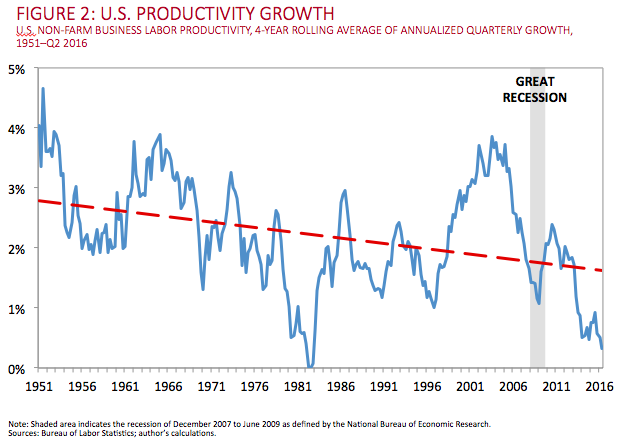
Wages have stagnated and business investment is also lagging given uncertain prospects.
As the report highlights, between the 1970s and 1990s, the US economy created private sector jobs at a long-run rate of 2% per year. But the rate, which began to decline around 2001, remains well below historical standards.
The report adds that not only has job growth slowed but most of the jobs created since 2000 have been in “local” industries such as health care, hospitality, and business services. Local jobs—as opposed to “traded jobs” that are exposed to international competitions such as machinery and IT equipment—pay lower average wages.
And slow job creation has led to low workforce participation, or the proportion of working age Americans in the active workforce, which peaked in 1997—well ahead of the Great Recession.
The report points out that while some observers have minimized declining workforce participation to retiring baby boomers, the bigger drivers are weak demand for low-skilled labor along with high incarceration rates of low-skilled men. Meanwhile, baby boomers are actually working longer than historical norms. While the official unemployment rate has improved to 4.9% for the entire population and 5.1% for the working population (ages 16-64), the report points out that if workforce participation stayed at the level seen in 1997, current levels of employment would imply a rate of 11.1% for the working population.
“Given the number of potential workers sitting on the sidelines, not in the official workforce but eligible to work, talk of a tightening labor market seems premature, especially for lower-skill and lower-income workers,” according to the report.
This helps set the stage for why wages and income levels for Americans have been under pressure, particularly for lower-income groups.

Meanwhile, the annual growth rate of quarterly private investment in intellectual property, structures and equipment remains weak, falling below historical rates, according to the report. For 2010-2016, the average quarterly investment by business as a percent of GDP was lower than it has been since the 1980s, hurting productivity further.
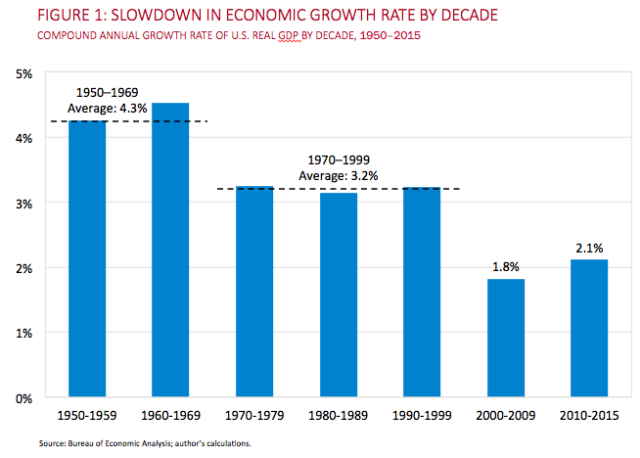
And all of this comes as GDP growth has remained tepid for a longer period than realized, on a downward trajectory since the 1960s with a significant step-down beginning around 2000.
Porter says the key barrier to progress is the political system.
“We’ve concluded after these five years of work on this that actually the political system and the political rhetoric is the problem at the core,” Porter said. “Because of the political gridlock we’ve not been able to make any progress on a lot of the basics.”
For more on the study, please see below:

Saturday, September 10, 2016
Consumer Reports Article - The Rise of Medical identity Theft
The Rise of Medical
Identity Theft
When thieves take your
personal data to get prescription drugs, doctor care, or surgery, it can
endanger your health and trash your finances
By Michelle Andrews
August 25, 2016
It began like an ordinary purse snatching. The credit card
reader on the gas pump at her Houston neighborhood station wasn’t working, so
Deborah Ford went inside to pay. By the time she returned to the car, her purse
and wallet were gone. Ford filed a police report, canceled credit cards, and
requested a new driver’s license and health insurance card. She checked with
the bank several times to be sure nothing was funny, then forgot about it.
Two years later, the retired postal worker
received an unsettling call from a bail bondsman; she was about to be arrested
for acquiring more than 1,700 prescription opioid
painkiller pills through area pharmacies.
“I had my mug shot taken, my fingerprints
taken,” she says. Ford suffers from psoriasis,
and she was so stressed that she broke out in the signature rash. “The policemen
looked at my hands and said, ‘That’s what drug users’ hands look like.’ They
just assumed I was guilty.”
Later, a judge dismissed the charges. “What
saved me from going to jail was that I had filed that police report,” Ford
says.
Turns out the thief altered Ford’s driver’s
license and used that and her stolen health insurance card
to go to doctors to seek prescription painkillers. Eventually, Ford says, a
pharmacist became suspicious and called police.
“Boy, the thieves messed me up,” Ford says now
of her lengthy and expensive ordeal, which began with the theft in 2008 and
didn’t end until she got her name cleared of the arrest record last year. “Once
they’ve got your identity, they’ve got you,” she says.
Inside Medical Identity Theft
Ford’s story is but one glimpse of what
medical identity theft can look like these days and why it has become a
fast-growing strain of identity theft, with an estimated 2.3 million cases identified
in 2014, a number that’s up almost 22 percent from the year before.
Your personal health insurance information,
including your Social Security
number, address, and email address, is valuable and vulnerable. When
it gets into the wrong hands it can be used to steal expensive medical
services—even surgeries—and prescription
drugs or to procure medical devices or equipment such as
wheelchairs.
Your medical identity is a commodity that can
be hijacked and used to falsify insurance claims or to fraudulently acquire
government benefits such as Medicare or
Medicaid. Your personal medical information may also be sold on the black
market, where it can be used to create entirely new medical identities based on
your data.
And more often than you might imagine, people
outright share their own medical coverage with an uninsured friend or family
member in need of care, which is against the law. (More on that later.)
Because current consumer protections aren’t
specifically designed for medical identity theft, experts warn, people need to
understand that they may have to take on extensive work to clear up fraudulent
bills. Some frustrated victims of medical identity theft simply give up and pay
the bills themselves.
But there’s another, far more dangerous
problem with medical identity theft: The thief’s own medical treatment,
history, and diagnoses can get mixed up with your own electronic health
records—potentially tainting and complicating your care for years to come. And
that isn’t a hypothetical problem.
“About 20 percent of victims have told us that
they got the wrong diagnosis or
treatment, or that their care was delayed because there was confusion about
what was true in their records due to the identity theft,” says Ann Patterson,
a senior vice president of the Medical Identity Fraud Alliance (MIFA), a group
of several dozen healthcare organizations and businesses working to reduce the
crime and its negative effects.
Havoc in Victims' Lives
The long tail on medical identity theft can
create havoc in victims’ lives. Take Anndorie Cromar’s experience. A pregnant
woman reportedly used Cromar’s medical identity to pay for maternity care at
a nearby hospital in Utah.
Soon, officials from child protective services
assumed the infant—born with drugs in her system—was Cromar’s baby, and Cromar
says the state, not realizing her medical identity had been hijacked,
threatened to take her own four children away.
A DNA test she took helped to get her name off
of the infant’s birth certificate, she says, but it took years to get her
medical records corrected.
“That first stage was the most terrifying
thing I’ve ever experienced in my life, getting the call from CPS and having
them say, ‘We are coming to take your kids,’ ” Cromar told Consumer Reports.

An Insidious Kind of Fraud
Financial identity
theft is nothing new: Perhaps you or someone you know has had
to deal with undoing the mess that happens when someone illegally obtains your
personal financial information and uses it to drain your bank account or
rack up charges on credit cards fraudulently
taken out in your name.
Setting credit accounts back to normal can be
a hassle, but your money is, for the most part, protected under the Fair Credit
Billing Act. You’re liable for only $50, at most, of unauthorized charges on a credit cardif
you follow simple notification steps. And there are defined reimbursement rules if money is illegally withdrawn with
a stolen ATM or debit card.
But when consumers become victims of medical
identity fraud, stopping the damage and clearing up the bills is much more
difficult and time consuming.
Deborah Ford had to quickly figure out what
had been done in her name and try to undo the damage. She got on the phone and
wrote letters and even tried to track down doctors the criminal had used. “All
I have is my name, my integrity,” she says.
Investigators later told her that the thieves
were savvy at knowing the system, always waiting 45 days between trips to the
same pharmacy to avoid being identified by store video. “They were so slick
about it,” Ford says. ‘To this day, I don’t know who they were. But they were
slick, that’s for sure.”
Spotting It, Preventing it
Experts say detecting the fraud in the first
place can be the most difficult part. “Medical identify theft and fraud is much
harder to spot than financial fraud,” says Michelle De Mooy, acting director of
the Privacy & Data Project at the nonprofit Center for Democracy &
Technology. “The bank calls you if they see charges in the system that raise an
alarm. This kind of fraud is much easier to hide for a longer time.”
That’s why consumers need to be especially
smart and careful about how and when they share their personal, medical, and
insurance information.
Here are a few basic ways you can safeguard
your medical privacy and identity: Read those explanation of benefits letters
as if they were bank statements. Carefully check all of the correspondence you
receive from health insurers and healthcare providers for accuracy and for
bills of service that you don’t recognize. Also review your credit reports for
unfamiliar debts. Be stingy with your personal health information, Social
Security card, and insurance cards. If someone asks for them, inquire whether
it is really necessary.
And don’t post news of an upcoming surgery on Facebook or
other social media outlets, Patterson recommends. You can’t really be sure who
might see it. Consider, for example, that a criminal could scoop up the notice
of your impending hip replacement and
add it to other information he or she can easily find about you online,
creating a more robust, more exploitable personal profile. As Eva Velasquez,
president and CEO of the ITRC, says, “Our rule of thumb is if it’s not
something you’d want plastered on a billboard, don’t post it. Because
essentially every single thing you post has that potential.”
All in the Family
Ronnie Bogle, a museum supervisor from San
Jose, Calif., says that for more than a decade, he had no idea that his brother
Gary had been stealing his identity to secure healthcare across several states.
Gary had a simple routine, Ronnie says: He
would move to a new town or city, purchase a picture ID, then present the ID—along
with Ronnie’s Social Security number—to get treatment, often at hospitals. Gary
often claimed to be uninsured when he sought care. After he was treated, the
bills were later sent to his given address, not Ronnie’s.
Ronnie told Consumer Reports that he only
learned what Gary was up to in 2010 after applying for a new credit card and
being turned down. He says his credit report contained listing after listing of
unpaid debt—for his brother’s hospital visits and treatments over the years.
Eventually, Gary was arrested and pleaded
guilty to 10 counts of criminal impersonation in California. He’s facing more
charges in Washington state for allegedly stealing his brother’s identity
there.
It has taken two years for Ronnie Bogle to
straighten out his credit and get his brother’s medical bills off his financial
record. “He destroyed my credit history multiple times,” Ronnie says.

So-Called Friendly Fraud
Sometimes victims of medical identity theft
know exactly how the crime occurred, but for others it remains a mystery.
The Ponemon Institute, a private cybersecurity
research firm, surveyed 1,005 people whose medical identity was “most likely”
assumed by someone else. In the study, published last year, 10 percent of
victims said their event was the result of a healthcare provider or insurer
data breach, and an additional 12 percent believe they were tricked into giving
up personal information via a fake email or phony website.
But 47 percent of respondents said that their
identity theft was perpetrated by a relative or someone else they knew.
Twenty-four percent said they had a situation like Bogle’s, where a relative
stole their identity without their knowledge or consent. And surprisingly, an
additional 23 percent of respondents said they willingly shared their
credentials with someone they knew. That’s why the crime sometimes is referred
to as “friendly fraud.”
Of those who said they shared healthcare
credentials in that way, 91 percent reported that it was because the other
person had no health insurance and 86 percent said it was because the other
person couldn’t afford medical treatment. Sixty-five percent said it was done
in an emergency.
Most of the people who voluntarily let someone
they know use their medical information said they didn’t consider their actions
wrong or criminal.
“They think of it as a Robin Hood crime—that
no one is getting hurt and that if a family member is ill, they can help them,”
says Larry Ponemon, chairman of the Ponemon Institute.
“Those in our studies who did recognize it as
a crime saw it as minor, like driving 5 miles above the speed limit. They don’t
recognize the cost burden to insurance companies or healthcare providers, or
that it ultimately ends up in the lap of consumers.”
Knowingly allowing a friend or relative to use
your medical insurance is illegal, an act of fraud against insurance companies
and health providers. And wrongfully sharing Medicare or Medicaid benefits is a
crime against the federal government and state programs.
Pinpointing how much money fraud costs the
medical industry each year is difficult. One estimate from 2012 put the total
economic impact of medical identity theft in the U.S. at $41.3 billion.
Providers are working on new strategies to
prevent it. They’re using software to detect fraud in billing, training staff
and consumers to recognize warning signs and asking for photo IDs, explains
James Quiggle of the Coalition Against Insurance Fraud. He says consumers can
expect to see more extensive verification screening in the future, such as the
use of fingerprints or palm prints. And soon Medicare cards will no longer bear
Social Security numbers.
A Dramatic Rise in the Crime
As recently as six years ago, your medical
information was kept in paper files, but now it has a more robust virtual
life—in electronic health records and in details you share online. All of that
can increase the likelihood that the wrong people could gain access to your
data.
“Now there’s electronic data traveling through
all kinds of devices and networks, and it’s much harder to lock it down,”
Patterson says.
Big data breaches in
the medical care industry have been on the rise over the past decade, including
the hack of health insurer Anthem in
2015, when about 70 million of its records were reportedly stolen. And yet it’s
still unclear how often medical identity fraud stems from those kinds of hacks,
Patterson explains.
Most at Risk for Medical Identity Theft
What industry analysts do know is that some
people are more likely to become targets, including people on Medicare. “That
Social Security number on the card is a gateway, not just to medical fraud but
to all kinds of fraud,” Patterson notes.
Older adults might also be more susceptible to scams because
they tend to be less circumspect about giving up personal health information,
she adds. Children’s health records are aggressively pursued by criminals, it
turns out, because a minor’s credit report—which would list unpaid debts—isn’t
usually seen by parents until a child is old enough to secure credit in his or
her name.
Also particularly vulnerable to medical
identity theft, says Pam Dixon, executive director of the nonprofit World
Privacy Forum, are new mothers, surgery patients,
and people with chronic conditions such as diabetes or
serious illnesses such as cancer.
That’s because the more interaction you have with the healthcare system, the
more opportunity for records to be breached.
Anyone who casually puts a lot of personal
information on social media sites and apps, such as millennials,
might attract medical identity thieves, too. Criminals, Patterson explains, are
“very good at aggregating social media information and pairing it with health
and other data they’ve gotten, like dates of birth and addresses.”
The Chaos in Care
The effects of medical identity theft can be
far-reaching, costing victims time, money, and aggravation. A 2016 report from
Javelin Strategy & Research found that, on average, identity fraud victims
spent only $55 out of pocket to resolve financial account problems in 2015.
But 65 percent of the medical identity theft
victims surveyed by Ponemon said they spent an average of $13,500 to pay the
healthcare bills run up in their name, to recover their health insurance, and
to pay lawyer’s fees, among other things. Ponemon also found that it took an
average of more than three months for victims to even detect the fraud and more
than 200 hours to undo the mess.
Mary Levine of Lake Charles, Louisiana, says
she has been logging time on the telephone with the police, hospitals, doctors,
and Medicaid almost every day since she learned in mid-June that someone had
racked up some $20,000 in fraudulent medical bills using her identity. Although
Levine is working closely with the nonprofit ITRC and her local sheriff's
department, the bills continue to arrive, and her worries are mounting.
"I keep telling the hospital that I've
never been there," says Levine. "I've been calling nonstop. They just
say they have not clarified anything at all and they'll call me whenever they
make a decision."
There’s much more to do to safeguard consumers
from medical identity theft, experts say, including creating a defined process
for resolving medical and financial problems.
But, says Orly Avitzur,
M.D., M.B.A., Consumer Reports’ medical director, one thing that healthcare
experts don’t want is to completely lock up our medical data. “It’s important
for doctors to be able to share your health needs, diagnoses, and treatment
information with each other, and to do so quickly in the event of an emergency,”
she says.
Be Ever-Vigilant
Deborah Ford’s encounter with medical identity
theft may have been extreme, but the way she handled it was impressive. Once
she found out about the fraud, she got on it—alerting every entity involved—
and stayed on it until it was over.
“They never used my credit card or checking account;
I checked. But lo and behold, they did more than that. They got what they
wanted—my insurance information,” she says.
Still, it cost her $1,500 in fees and took
five more years to expunge the drug arrest. On that day, Ford says, “I got my
name back.”
Subscribe to:
Posts (Atom)